Beiträge
-
 Widerspruch als Erzählprinzip in der Vormoderne? Eine Projektskizze
In premodern narratives contradictions are omnipresent – conflicting concepts, logical inconsistencies, acts of objection. In a narratological perspective ›contradiction‹ – conflicts of incompatible knowledges and narrative patterns; inconsistencies in or between speech (by narrator or characters) and action; contradictory or inconsistent information and motivation – is apt to subvert, complicate, or enrich the textual production of meaning. The project ›Contradiction as a Narrative Principle in Premodern Narrative‹ (University of Bremen) explores different types of contradictions in medieval epic and romance.
-
 Erzählen in transkultureller Perspektive. Zur Poetologie der Widersprüche in der europäischen Heldendichtung
In Kasten, Ingrid & Laura Auteri (Hrsg.) Transkulturalität und Translation. Deutsche Literatur des Mittelalters im europäischen Kontext: 243–252. Berlin: De Gruyter. DOI: 10.1515/9783110556438-017
-
 Antagonismus und Antagonismen – hegemonietheoretische Aufklärung
In Oliver Marchart (Hrsg.) Ordnungen des Politischen. Einsätze und Wirkungen der Hegemonietheorie Ernesto Laclaus, 81–102. Wiesbaden: Springer VS. printISBN: 978-3-6581-7258-9 ebook ISBN: 9783-6581-7259-6
-
 Discourse Analysis as Critique
This paper intervenes in the discussion about the relationship between discourse analysis and critique. It argues that this relationship can be understood either as an external or as an integrated relationship. In an external relationship, there is first social criticism that is then braced by discourse analysis, that is, the latter aims at giving empirical credence to the critique. However, such an external relationship cannot give us any insight concerning the critical potential that is specific to discourse analysis, precisely because in this case critique exists before and independent of discourse analysis. If, however, critique emanates from discourse analysis itself, we would speak of an integrated relationship and would no longer speak of discourse analysis and critique, but of discourse analysis as critique. It is argued that such an integrated relationship becomes visible once we think of discourse analysis as being itself a discursive formation and ask what unsettling effects this formation has on research objects, on subject formations and on the academic production context in which they are conducted.
-
 Krisenanalyse und radikale Theorie der Demokratie
Mittelweg 36. Zeitschrift des Hamburger Instituts für Sozialforschung 2(2016). ISBN: 978-3-86854-736-8
-
 „Sascha, ich würde Dir gern glauben, aber versteh auch Du mich …“. Breschnew, Dubček und die Frage von Kadern und Vertrauen im Konflikt um den Prager Frühling 1968
Im Mittelpunkt dieses Beitrags steht die Frage, mit welcher Art von Diplomatie wir es in den Warschauer-Pakt-Staaten zu tun haben. Am Beispiel der Invasion in der Tschechoslowakei 1968 werden drei Thesen diskutiert: (1) Breschnew übertrug sein innerparteiliches Konzept des „Kadervertrauens“ und sein auf Vertrauen basierendes „Machtszenario“ auf die Außenpolitik und behandelte Dubček als Klienten, den er patrimonial und familiär ansprach. (2) Er verlor das Vertrauen in Dubček, als dieser einen neuen demokratischen Diskurs etablierte, der die zentrale Macht der Partei leugnete. (3) Die diplomatische Sprache innerhalb der Warschauer-Pakt-Staaten bezog sich mehr auf die gemeinsamen sozialistischen Werte und die Parteidisziplin als auf die Sprache und den Rahmen der internationalen Treffen mit Drittstaaten.
-
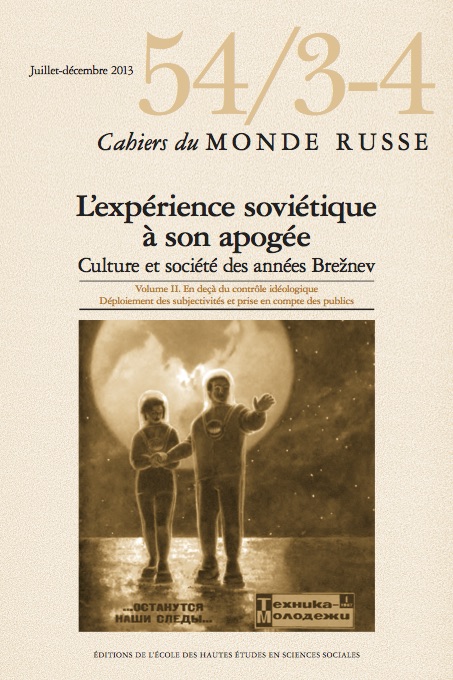 Les frontières du dicible. Du dialogue au silence: Les relations d’Andrej Saharov avec Hrušcev et Brežnev.
This article describes the historical context that was decisive in Saharov’s commitment to warning party leaders of the dangers of the H-bomb and calling on them to respect human rights. He also attempts to explore the different ways in which Hruščev and Brežnev approached Saharov’s criticisms. Not only does he examine the three stages of the KGB model – educate, warn and only finally arrest renegades – he also sheds light on Andropov’s repeated appeals to Brežnev to speak with Saharov. Although Saharov, too, was keen to talk to Brežnev, the meeting between the two men never took place. In the end, it was against the backdrop of the Cold War that the Politbjuro decided on the best time to get rid of Saharov, doing as little damage as possible to the prestige of the Soviet Union, and thus re-establishing the limits of the dictable.
-
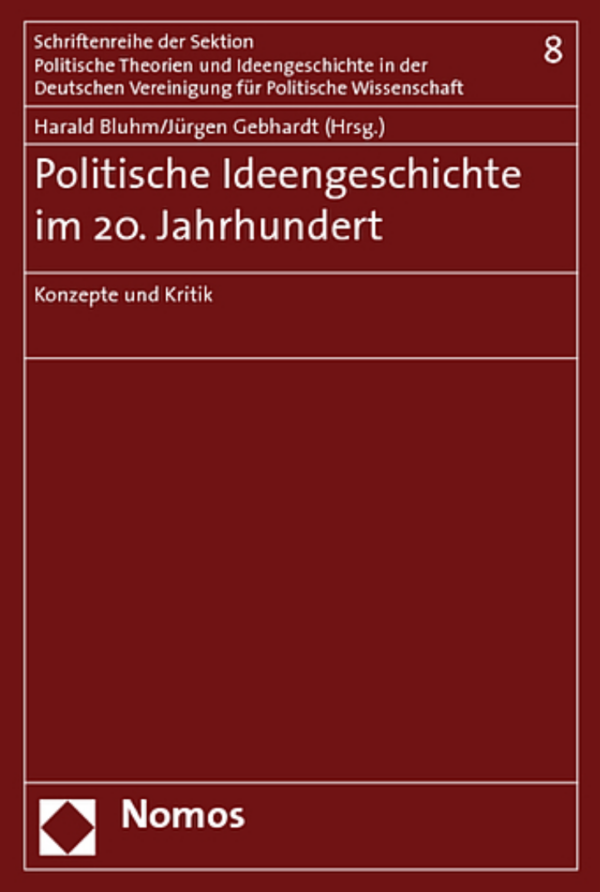 Politische Ideengeschichte und politische Hegemonie. Anmerkungen zum ‚Battle of the Books‘ an den amerikanischen Colleges
In Bluhm, Harald & Jürgen Gebhardt (Hrsg.) Politische Ideengeschichte im 20. Jahrhundert, 223–242. Baden-Baden: Nomos. ISBN: 978-3-8329-2181-1